
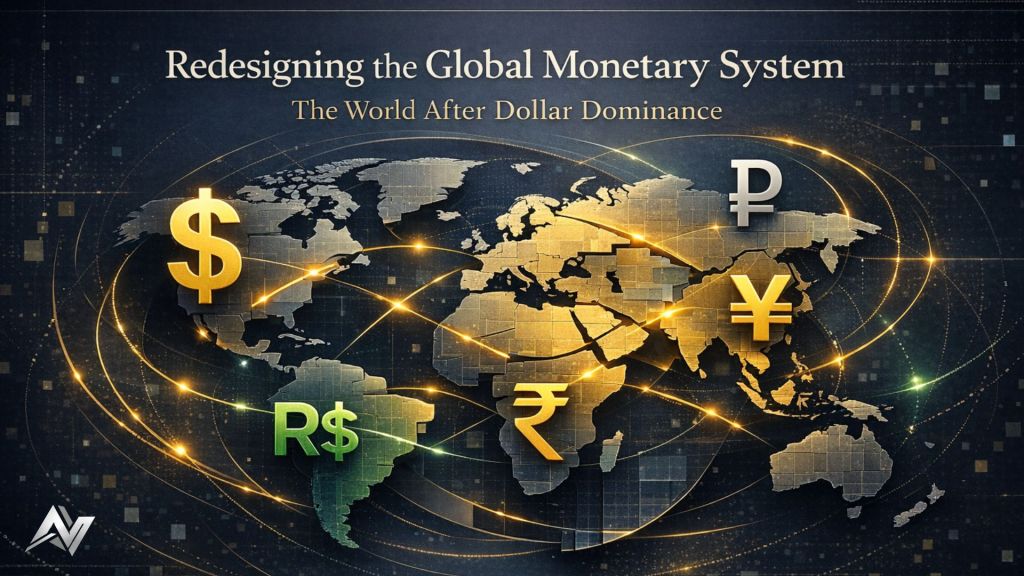
The global economy is entering a phase of structural fragmentation. Rising tariffs, expanding sanctions, and increasingly disrupted trade routes are accelerating a shift that has been building for years: the gradual diversification away from exclusive reliance on the U.S. dollar and the emergence of BRICS and other multipolar currency systems.
This is no longer a future scenario. It is an operational reality unfolding across trade flows, financial infrastructure, and supply chains worldwide.
Across a growing number of economies in BRICS and other major economies, trade is increasingly settled in local or regional currencies rather than exclusively in dollars. China’s yuan now accounts for a significantly higher share of its cross-border transactions than a decade ago. Several countries have established local-currency trade mechanisms with multiple partners. Some major oil producers are conducting sales in currencies beyond the dollar. What began as a geopolitical risk-management response has evolved into a broader realignment of how commerce is conducted. The implications extend well beyond governments and central banks, they now sit squarely with corporate leadership teams.
For global businesses, the question is no longer whether this matters, but how quickly they adapt.
From Cost Optimization to Resilience Economics
For decades, global strategy was built around efficiency: dollar-denominated contracts, centralized procurement, and geographically concentrated production optimized for cost. That model is now under sustained pressure.
As currency systems fragment and geopolitical risk becomes a persistent feature rather than a temporary shock, companies are being forced to rebalance away from pure cost optimization toward resilience-first strategies. Friend-shoring, near-shoring, and the development of strong regional operating hubs are becoming standard capabilities rather than contingency measures.
At the same time, economies outside the traditional transatlantic core now represent a substantial and growing share of global GDP, manufacturing capacity, and consumer demand. Emerging and developing economies now account for over 58% of global GDP measured at purchasing power parity. For many multinational firms, future growth increasingly depends on deeper financial and operational integration across multiple currency zones.
Where the Pressure Is Emerging First
The effects of currency realignment are already visible across three critical enterprise dimensions:
Treasury and Working Capital
Local-currency settlement expands exposure beyond the dollar into a broader set of currencies, many of which lack deep, low-cost hedging markets. Firms operating with treasury models designed for a dollar-centric world face conversion friction, longer settlement cycles, and incremental margin erosion that compounds over time. Manufacturing firms with significant supplier bases in Asia report transaction cost increases of 15–25 basis points per conversion when moving away from dollar settlement, while treasury teams cite 2–3 day delays in working capital availability when navigating less liquid currency pairs.
Supply Chains
Suppliers are increasingly pricing and requesting payment in local or regional currencies. Companies that insist on dollar-only terms often incur higher effective costs, slower transactions, and reduced access to preferred suppliers, disadvantages that become material at scale. Major electronics and automotive suppliers in key markets now routinely offer 2–5% pricing discounts for local-currency settlement versus dollar terms.
Market Access
Regulatory regimes are evolving to favor companies that demonstrate local economic participation. Financial integration, reinvestment, and domestic value creation are increasingly implicit requirements for participating in procurement, infrastructure projects, and regulated markets. In several fast-growing economies, foreign firms report preference scoring advantages in public tenders when demonstrating local banking relationships and domestic reinvestment commitments.
The Often-Missed Talent Dimension
Currency realignment is not only a finance or supply-chain issue, it is a talent issue.
An increasing share of globally mobile talent now evaluates compensation, equity, and career opportunity through a local-currency and local-purchasing-power lens. As regional currencies strengthen or stabilize relative to the dollar, headquarters-based compensation packages lose purchasing power locally, while equity grants denominated in parent-company currency expose employees to exchange-rate volatility they cannot control. Dollar-anchored compensation structures can unintentionally transfer currency risk to employees, weakening the perceived attractiveness of multinational roles.
Organizations that adjust by aligning compensation frameworks with local market realities, introducing regional equity programs, and building credible leadership pathways outside headquarters are strengthening retention and leadership depth in growth markets.
How Leading Companies Are Responding
Organizations navigating this transition effectively tend to share several characteristics:
· Multi-currency treasury capabilities embedded regionally rather than centralized exclusively at headquarters
(Example: European industrial firms are establishing regional treasury centers in Singapore and Dubai with autonomous hedging authority and direct local banking relationships)
· Supply-chain finance models designed around currency corridors instead of imposed dollar terms
· Regional profit centers with reinvestment mandates, positioning the firm as a long-term participant rather than a transactional entrant
· Talent strategies aligned to local purchasing power and competitive realities, not just global averages
These are not cosmetic adjustments. They require sustained investment, governance changes, and executive alignment but they also create structural advantages that are difficult for competitors to replicate quickly.
It is worth noting that the dollar still plays the dominant role in global foreign exchange markets, representing approximately 88% of all currency transactions as of 2024. For firms with limited exposure to emerging markets or highly concentrated operations in dollar-zone economies, the urgency of this transition may be lower. However, for organizations with meaningful supply-chain, revenue, or talent footprints across multipolar currency regions, the competitive and operational implications are immediate.
A Strategic Imperative
The deeper reality is this: currency diversification is reshaping competitive advantage at the enterprise level.
Organizations that treat this primarily as a hedging or treasury issue are mispricing its strategic impact. Those that recognize it as a whole-enterprise transformation spanning strategy, operations, talent, and market access are positioning themselves for resilience and relevance in a more fragmented global economy.
In an increasingly multipolar world, dependence equals vulnerability.
Diversified resilience is becoming the new source of competitive strength.
Just this week, the recently announced India–US trade agreement provides a useful example of how bilateral diplomacy can deliver short-term tariff relief and greater stability in select trade flows. Agreements like this help manage immediate pressures and create breathing room for businesses operating in the current environment. At the same time, they operate alongside a broader, longer-term evolution in global trade toward greater use of local and regional currencies. This ongoing shift reflects the growing economic weight of diverse markets and the increasing complexity of cross-border commerce. Companies that view such bilateral deals as opportunities to strengthen diversified supply chains, multi-currency capabilities, and overall resilience will be better prepared for a more fragmented global economy.
The question for leadership teams is simple:
Are we still managing tomorrow’s markets with yesterday’s assumptions?
References
· International Monetary Fund, World Economic Outlook Database, October 2024
· Bank for International Settlements, Triennial Central Bank Survey of Foreign Exchange and OTC Derivatives Markets, December 2024
· McKinsey & Company, Global Supply Chain and Operations Survey, Q4 2024
· Society for Worldwide Interbank Financial Telecommunication (SWIFT), RMB Tracker Monthly Reports, 2024
· Public statements and policy releases from major central banks and trade ministries, 2024–2025
 ARYON VANCE
Leave a comment