
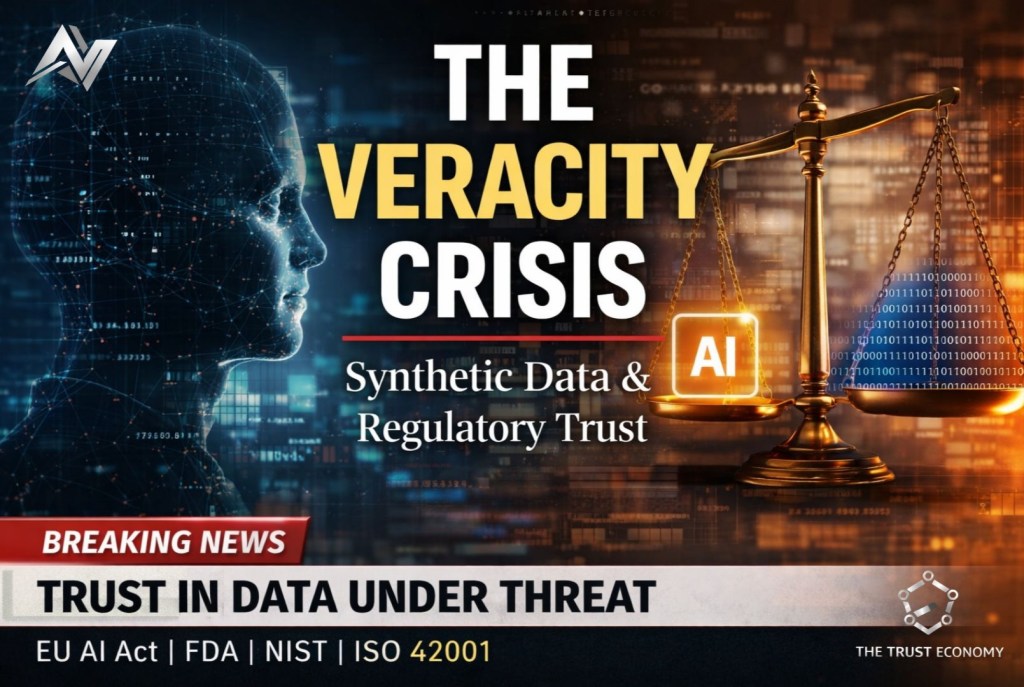
In the quiet architecture of modern innovation, a subtle tension is emerging. As organizations race toward hyper-growth, the data that fuels their decisions is no longer a passive resource. It has become a living, mutable substance – shaped, augmented, and sometimes quietly transformed in the pursuit of speed. This is the heart of the Trust Economy: the recognition that in an era of synthetic data, the true limiting factor for scaling is not capital, talent, or technology, but the fragile thread of verifiable truth.
The question is no longer whether data exists. It is whether we can still trust it.
This tension is most acute in the regulated industries that directly touch human lives: pharmaceuticals, food and nutrition, and health wearables. Here, the stakes are not abstract. A new drug, a novel food ingredient, or a wearable health marker approved on compromised data can have real, irreversible consequences. And yet, the pressure to accelerate – to bridge real patient data with synthetic cohorts, to smooth anomalies for statistical significance, to present compelling case studies to regulators – is immense.
The result is a growing concern that is rarely spoken aloud but deeply felt: the slow erosion of data veracity.
The Three Dimensions of Data Trustworthiness
At the core of this concern lie three interdependent dimensions that must be understood as a multi-factor index to assess authenticity in the Trust Economy:
- Veracity – Is the data what it claims to be? Has it been tampered with, subtly altered, or synthetically generated in ways that distort reality?
- Transformation Integrity – How much has the data changed as it moved through pipelines? Were legitimate preprocessing steps applied, or were convenient adjustments made to improve outcomes?
- Sufficiency – Is the dataset truly representative and complete enough to support the claim? Or has selective sampling or augmentation created an illusion of robustness?
These three dimensions form the Data Veracity Quotient – a composite measure of whether data is value worthy: authentic, traceable, and morally grounded. Without such an index, organizations and regulators are forced to rely on narrative assurances rather than verifiable proof.
The temptation to bridge real patient data with synthetic cohorts is understandable. In hyper-competitive markets, the pressure to launch faster is immense. Synthetic data can fill gaps, accelerate trials, and strengthen statistical power. But when that data is presented without transparent provenance, it undermines the very foundation of regulatory trust.
Consultants and the Art of Tempered Narratives
A particularly insidious form of this erosion comes from well-intentioned (or commercially motivated) consultants. They are hired to deliver compelling case studies and regulatory submissions. In the process, data is “cleaned,” “normalized,” or “augmented” in ways that are technically defensible but ethically ambiguous. The final report looks pristine. The regulator sees a polished story. The underlying reality – the transformations, the sufficiency gaps, the selective inclusion – remains hidden.
This is the dark side of the Trust Economy: when the incentive structure rewards persuasive narratives over verifiable truth, organizations begin to optimize for approval rather than authenticity.
Culture and Values: The Human Fabric Behind Data Trust
Data trustworthiness does not exist in a vacuum. It is deeply intertwined with organizational culture and values. Culture is the homogeneous fabric that evolves from people – individualistic actors who, under pressure, may prioritize survival over service. When culture favors harmony over disruption, hard calls are avoided, and intellectual float (surplus talent causing endless debate) thrives. When values are treated as posters rather than lived principles, data is tempered to fit the narrative rather than the truth.
In the Trust Economy, culture must shift from sycophantic harmony to disruptive transparency, and values must move from whims to potent ethics (potential plus morally grounded intent). Only then can data veracity, transformation integrity, and sufficiency be meaningfully enforced. Data indices become as important as values and culture in an organization – they are the measurable expression of whether the organization truly lives its principles.
The Regulatory Imperative in a Trust Economy
Regulators in the pharmaceutical, food and drug, and health wearable spaces are increasingly aware of this vulnerability. The EU AI Act, FDA guidance on Real-World Evidence, and similar frameworks in other jurisdictions are beginning to demand greater transparency around data provenance, transformation history, and reproducibility. But current tools – logs, dashboards, and narrative reports – are no longer sufficient. They offer stories, not cryptographic proof.
The Trust Economy demands a higher standard: mathematical certainty that the data used for R&D, clinical trials, safety assessments, and market authorization is authentic, unaltered in unauthorized ways, and sufficient for the claim being made.
This is not a call to slow innovation. It is a call to make innovation responsible and sustainable. Organizations that can prove their data is value worthy – authentic, traceable, and morally grounded – will earn faster approvals, stronger stakeholder confidence, and a genuine competitive moat.
The alternative is a future in which regulators, clinicians, and consumers grow increasingly skeptical of AI-driven claims. In that world, the cost of rebuilding public trust will far exceed the cost of building trustworthy systems today.
The Path Forward: Data Indices as Foundational as Values and Culture
In the Trust Economy, data indices – the Data Veracity Quotient, Transformation Index, and Sufficiency Score – are as important as values and culture in an organization. They are not technical afterthoughts. They are the measurable expression of whether an organization truly lives its principles of transparency, ethical intent, and disruption over harmony.
Regulators, R&D leaders, and founders who embrace this reality will build organizations that scale with integrity. Those who ignore it will find that speed without trust is merely momentum toward collapse.
The Trust Economy is not coming. It has already arrived.
The only question is whether we will build our scaling organizations – and our regulatory frameworks – on sand, or on something far more durable.
References
- FDA Real-World Data and Real-World Evidence Guidance (2024–2025)
- EMA DARWIN EU Initiative Report (2024)
- EU AI Act (2024)
- NIST AI Risk Management Framework 1.0 (updated 2025)
- Gartner “Trustworthy AI” Hype Cycle (2025)
- McKinsey “The State of AI in 2025”
- World Economic Forum “AI Governance Alliance” White Paper (2025)
- Deloitte “Digital Trust in Regulated Industries” (2024)
- ISO 42001 AI Management Systems Standard (2024)
#TrustEconomy #TrustedAI #AITrust #DataTrust #DigitalTrust #AIgovernance #CorporateGovernance #RegTech #FDA #GMP #RegulatoryCompliance #DigitalRegulation #EthicalAI #ResponsibleAI #PharmaRegulation #FoodSafety #HealthWearables #MedicalDevices #ClinicalTrials #FoodRegulation
 ARYON VANCE
Leave a comment