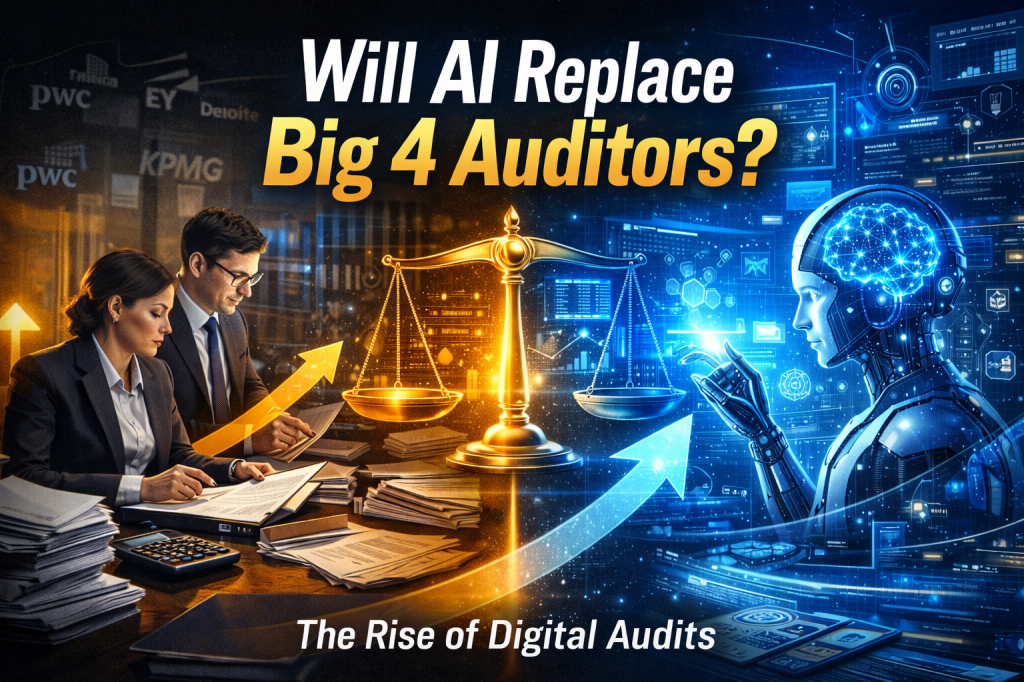
In the relentless march of corporate finance and regulatory scrutiny, the traditional audit model—dominated by Big Four auditors crisscrossing global sites, interrogating teams, and piecing together fragmented reports—feels like an artifact from a pre-digital age. But will this model, long underpinned by the prestige of Big 4 firms and McKinsey, Bain, or Boston Consulting Group (MBB) consultancies, retain its meaning as AI-driven innovations take center stage? Enter digital audits: a disruptive paradigm that harnesses automation tools, process analytics, and artificial intelligence (AI) to audit processes rather than people. This shift isn’t just about streamlining; it’s about questioning the very relevance of human-led audits in a ‘trust economy’ where faith in agentic AI—such as Anthropic’s Claude models—rivals the historic reliance on Big Four and MBB for audits and advisory. As AI learns to predict risks and automate compliance, could the era of expensive, travel-heavy audits be fading? Let’s explore how digital audits are reshaping governance, integrating with emerging standards, and why AI could soon eclipse human auditors, fostering a new era of unbreakable trust.
The Shift: Auditing Processes, Not People
Digital audits flip the script on conventional methods. Using accessible automation tools and analytics platforms, organizations map workflows in real-time, analyzing transactional data to uncover discrepancies between intended and actual operations. These technologies handle repetitive tasks and expose inefficiencies hidden in data streams. This creates a unified digital ecosystem embedding financial controls and policies, advancing processes from chaotic ad hoc states to fully optimized maturity.
The question looms: Do Big 4 audits, with their human-centric interrogations and site visits, still hold value when AI can deliver continuous, bias-free insights? In high-growth firms or family enterprises, where processes evolve rapidly, digital audits offer scalability without the logistical burdens. Cost savings alone—estimated at 20-30% from eliminated travel and faster cycles—raise doubts about the sustainability of traditional models. As AI learns from vast datasets, it performs root cause analysis (RCA) and suggests corrective/preventive actions (CAPA), potentially rendering MBB’s advisory roles redundant in routine compliance.
Self-Audits: The Innovative First Line of Defense
At the heart of this disruption is self-audits as an innovative first line of defense, powered by structured risk mapping tools integrated with analytics platforms. This dynamic approach enables business units to self-validate proactively. Combined with automation for routine checks and data-driven insights for revelations, it forms a potent arsenal that questions the need for external Big 4 interventions. The second line—risk management and compliance—employs AI analytics to oversee outcomes, aligning with strategic financial alignment. The third line, internal audit, validates via predictive tools, targeting high-impact risks.
This framework prompts reflection: If self-audits detect issues early, fostering process awareness and plugging gaps before crises, why cling to MBB’s high-touch consultations? In family businesses or startups, it promotes resilience, but it also erodes the monopoly of traditional auditors, pushing the industry toward AI-centric trust.
AI’s Ascendancy: Learning, Replacing, and the Trust Economy
AI elevates digital audits to new heights. As agentic models like Anthropic’s Claude ingest audit histories, they learn patterns, simulate risks, and execute autonomous audits—outpacing human speed and accuracy. Will Big 4 audits maintain relevance when AI handles everything from compliance checks to predictive forecasting? This evolution births a ‘trust economy,’ shifting reliance from human institutions like Big 4 and MBB to anthropic AI systems. Blockchain-secured trails ensure transparency, potentially surpassing human objectivity and reducing bias in regulatory regimes.
For family firms pursuing perpetuity or startups in hyper-growth, AI-driven audits mean agile governance without escalating costs. Yet, as AI replaces internal/external roles, it challenges the Big 4’s value proposition: Do their expertise and networks justify premiums when AI delivers comparable—or superior—results at scale?
Aligning with Latest Audit Trends and Standards
Digital audits intersect with 2025-2026 trends questioning traditional models. The Institute of Internal Auditors’ (IIA) Global Internal Audit Standards (January 2025) demand tech proficiency, including AI and cybersecurity, diminishing the edge of human-only Big 4 audits. PCAOB’s QC 1000 (December 2025) mandates risk-based quality, favoring AI’s precision over MBB’s manual approaches.
Continuous auditing dominates: AI enables real-time monitoring, per Deloitte’s 2025 report, slashing times by 25% amid shortages (IIA Pulse 2025 notes 55% auditor gaps). ESG scrutiny intensifies—AI parses data for SEC compliance, with PwC (2025) surveying 60% CFOs prioritizing it, sidelining traditional methods. Cybersecurity evolves: Fannie’s August 2025 rules require AI oversight, while SEC’s 2026 AI governance emphasizes ethical deployment, potentially eroding MBB’s advisory dominance.
Challenges like GDPR privacy persist, but frameworks like NIST’s AI Risk Management (2023 update) ensure responsible AI, making digital audits more reliable than human variants.
The Future: A Call to Action
As digital audits rise, the Big 4 and MBB must adapt or risk irrelevance. AI’s learning curve promises a trust economy where anthropic tech commands the same authority as legacy giants, delivering cost efficiency, early risk detection, and scalable transformation. For businesses worldwide, this means rethinking audits: Embrace AI or cling to the past?
What do you think—will Big 4 audits endure? Share your views below as we navigate this shift.
DigitalAudits #AIinAudit #FutureOfAuditing #TrustEconomy #AgenticAI #ArtificialIntelligence #AIGovernance #AuditInnovation #ContinuousAuditing #AuditTransformation #CorporateGovernance #RiskManagement #Compliance #InternalAudit #SelfAudit #ProcessAnalytics #AutomationInFinance #FinTechInnovation #DataDrivenDecisions #PredictiveAnalytics #BlockchainAuditTrail #DigitalTransformation #BusinessTransformation #GovernanceTechnology #RegTech #ESGCompliance #CyberRiskManagement #StrategicFinance #FutureOfWork #NextGenGovernance
 ARYON VANCE
Leave a comment