
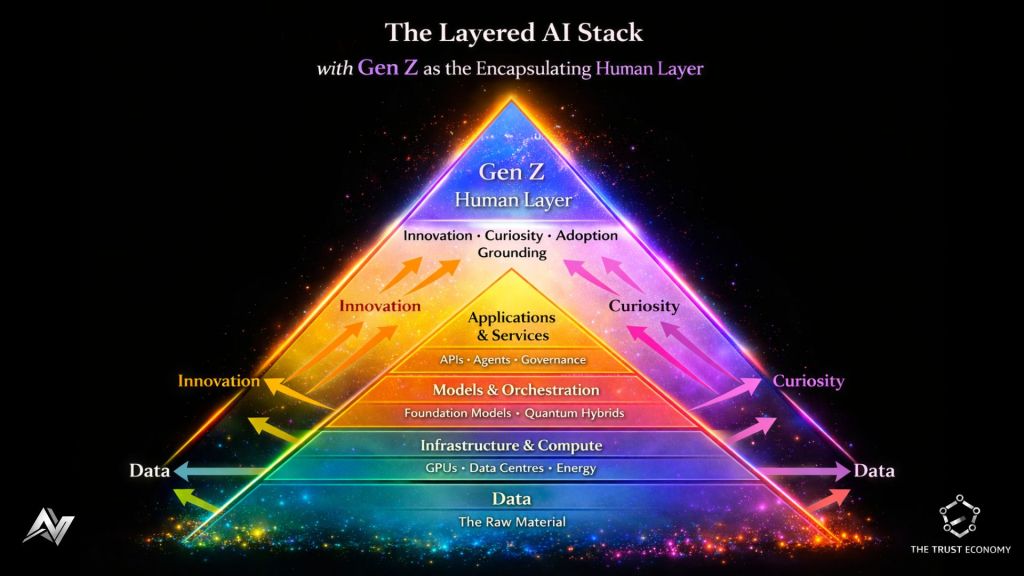
For more than fifteen years, the AI narrative has unfolded like a classic technology stack story – clean, linear, and almost entirely technical. We began with data – the raw, exploding fuel that turned Python notebooks into predictive engines. Then came the brutal realization that data without computers is worthless: GPUs dethroned CPUs, hyperscale data centers devoured entire cities’ worth of electricity, and energy became the new geopolitical chess piece. Today, quantum computing is hybridizing with classical systems, promising to crack problems that have resisted us for decades. Each layer felt like a new floor in a skyscraper being built skyward.
Yet the entire skyscraper still needs a guiding intelligence that can see the whole structure, redesign any floor on demand, and infuse every level with fearless curiosity. That guiding intelligence is now arriving at a planetary scale in the form of Gen Z (born 1997–2012) – the first generation that has never known a world without AI as native infrastructure. This is not a “people” or “diversity” footnote. It is the structural encapsulating force of human innovation – a larger pyramid that surrounds and permeates the inner technology stack pyramid, touching and elevating the core, the middle service layer, and the outer application/adoption layer simultaneously. Gen Z STEM graduates bring an unmatched fearlessness toward hard sciences – physics, chemistry, and advanced mathematics – and this curiosity is now the overarching force that accelerates innovation from frontier research all the way to go-to-market strategy and mass adoption.
Nowhere is this encapsulating pyramid force more visible – or more strategically decisive – than in countries with youthful, growing populations. Nations across Asia, Africa, and Latin America are gaining a multi-decade demographic dividend while many economies in Europe, East Asia, and North America age at unprecedented speed. This is not just sociology; it is the new source of comparative advantage in the AI era. The nations that harness their Gen Z (and emerging Alpha) talent wave fastest will own the next chapter of technological and economic history.
This article traces the stack’s evolution using the latest data available in March 2026: the IEA’s Electricity 2026 report (released February 2026), the Stanford AI Index 2025 (the most recent comprehensive edition), McKinsey’s Quantum Technology Monitor 2025, Deloitte’s 2025 Gen Z and Millennial Survey (global findings), and UN demographic projections. It then repositions Gen Z as an outer, encapsulating human pyramid: this pyramid envelops the inner technology layers (data, infrastructure, applications), both surrounding and permeating them. Gen Z, as this outer pyramid, radiates influence inward and outward, accelerating innovation at every level. The evidence-based hypothesis: 2026–2035 is the decade when this human force becomes the ultimate multiplier, collapsing decades of progress into years and shifting global AI leadership toward youthful nations. By 2040–2050, this external pyramid will mature into a global talent mesh, making AI’s benefits as widespread as electricity.
Phase 1: The Data Layer (~ 2010 – 2018) – Turning Floods into Meaning
The story opened with volume. Global data creation surged from roughly 2 zettabytes in 2010 to more than 20 zettabytes by 2018 – and then kept exploding. Enterprises discovered that competitive advantage lay not in storage but in extracting patterns at scale. Python became the universal language; libraries such as pandas, NumPy, scikit-learn, and early versions of TensorFlow turned thousands of analysts into citizen data scientists. Kaggle transformed model-building into a global spectator sport and talent pipeline, while platforms like Tableau and Power BI made descriptive analytics accessible to non-coders.
Descriptive analytics (“what happened?”) quickly evolved into diagnostic (“why did it happen?”), predictive (“what will happen?”), and early prescriptive stages. Historical McKinsey analyses from that era showed that companies aggressively using advanced analytics were already posting 5–6% productivity lifts in targeted functions by 2018. Yet the ceiling was obvious even then: models were narrow and domain-specific, data remained fragmented across silos, and compute hunger was rapidly becoming the binding constraint. Most organizations never left the dashboard era. The phrase “AI winter” still echoed in boardrooms, reminding everyone that hype without infrastructure leads nowhere.
Real-world examples illustrate the phase perfectly. Leading streaming platforms used collaborative filtering of user behavior data to drive most of the viewing and generate billions in retained revenue. Global retailers optimized inventory through transaction and supply-chain data, shaving hundreds of millions off costs annually. Early e-commerce and fintech players mined customer data to personalize offers and credit decisions, planting the seeds for explosive growth in digital services. Banks experimented with fraud-detection models on transaction logs, reducing losses by double-digit percentages. Large-scale government databases created some of the world’s largest clean datasets for public-service analytics.
This phase proved data’s strategic value beyond doubt – but also its fragility without the next layers. Data scientists spent 70–80% of their time cleaning and preparing data rather than innovating. The inner pyramid was crying out for massive parallel processing power and, ultimately, for an outer human force capable of reimagining what “meaning” even means.
Phase 2: The Infrastructure Layer – GPUs, Data Centers, and the Energy Awakening (2018- 2025 and Accelerating)
The transformer revolution and large language models changed everything overnight. AlexNet in 2012 had already hinted at the shift – two consumer GTX 580 GPUs outperformed thousands of CPUs on image recognition. By 2018–2019, the GPU became indispensable. NVIDIA’s data-center revenue trajectory is now legendary: from a modest base pre-ChatGPT to dominating the market with 86–92% share in AI accelerators, thanks to the CUDA software moat and relentless architecture leaps (Ampere => Hopper => Blackwell => and the 2026 Rubin series already in deployment).
The IEA’s Electricity 2026 report (February 2026) provides the definitive update: global data-center electricity consumption reached 415 TWh in 2024 – 1.5% of worldwide electricity – after growing 12% annually for the previous five years. The base-case projection to 2030 remains 945 TWh, more than doubling in six years and growing at ~15% per year – four times faster than the rest of the global economy. In the United States alone, data centers consumed 183 TWh in 2024 (over 4% of national electricity) and are forecast to reach 426 TWh by 2030. AI-specific workloads are the primary driver: accelerated servers are projected to grow electricity demand at 30% annually, pushing AI’s share of data-center power from 5–15% today to 35–50% by 2030. Some longer-range forecasts see global data-center demand approaching 1,300 TWh by 2035.
Sustainability teams moved from the periphery to the boardroom overnight. Hyperscalers signed nuclear restarts, massive renewable power purchase agreements, and began exploring next-generation geothermal and even fusion pilots. Hardware efficiency improved dramatically – performance-per-watt gains of ~40% annually across recent generations – yet absolute demand surges because both model size and global usage continue to explode. Training a single frontier model can consume electricity equivalent to hundreds of households for months; inference at a planetary scale is even more voracious.
Energy is no longer background infrastructure; it is now a core strategic, environmental, and geopolitical layer within the inner technology pyramid. Meanwhile, the outer Gen Z pyramid is already making an impact on this layer—challenging old constraints and designing more efficient architectures. As the surrounding human layer, Gen Z refuses to see energy limits as immovable and pushes for solutions.
Phase 3: Quantum and Hybrid Intelligence – The Convergence Frontier (2024 Onward)
Classical limits are now in sight. Even exascale supercomputers and optimized GPUs struggle with certain problems in molecular simulation, large-scale optimization, cryptanalysis, and materials discovery. Quantum computing entered commercial discourse in earnest in 2025.
McKinsey’s Quantum Technology Monitor 2025 (still the authoritative reference in March 2026) projects the total quantum technology market reaching up to $97 billion by 2035, with quantum computing alone growing from roughly $650–750 million in 2024 revenue (and surpassing $1 billion in 2025) to as much as $72 billion by 2035. Quantum communication and sensing add another $18–25 billion in the same timeframe. By 2040, the combined quantum technology market could reach $198 billion. Public funding globally exceeds $42 billion; private investment continues despite fewer but larger deals.
AI and quantum are mutually reinforcing. Machine-learning techniques accelerate quantum error correction and qubit stabilization. Quantum simulation, in turn, speeds up AI research in chemistry, drug discovery, and optimization. Hybrid classical-quantum workflows are moving from labs into early pilots across chemicals, finance, pharma, and logistics. Fault-tolerant scalable quantum advantage is now discussed in the 2030–2032 timeframe in optimistic scenarios, with meaningful economic impact unfolding over the following decade.
The inner pyramid is converging and accelerating – yet every convergence still requires the outer human pyramid to translate quantum advantage into real-world products, ethical frameworks, and scalable deployments. Gen Z’s comfort with the hard sciences is precisely what makes this translation possible at speed.
The Demographic Dividend: Why Certain Countries Win the Gen Z Race
Here, the narrative shifts from technology to geopolitics. Not all nations have equal access to the outer encapsulating pyramid force.
According to UN World Population Prospects and CIA World Factbook 2025–2026 estimates, the global median age stands at approximately 31 years. Africa remains the youngest continent, with many nations under 20. Asia’s youthful economies sit around 29–31 years with hundreds of millions under 25. In contrast, many economies in Europe, East Asia, and North America are rapidly ageing, with median ages above 45 and shrinking working-age populations. By 2050, the world’s largest workforces will be concentrated in the youthful Global South.
In 2026 alone, an estimated 85% of all babies worldwide will be born in Asia and Africa. This creates a multi-decade “youth bulge” advantage for youthful nations. Their working-age populations will continue expanding while others face labor shortages, pension pressures, and slower adoption cycles.
The implication for AI is profound. Countries with large, STEM-curious Gen Z cohorts can deploy the outer encapsulating pyramid force at every level – from core physics-driven breakthroughs to middle-layer service innovation to outer application and adoption. Leading reports show these youthful markets already hold a growing share of the global AI talent pool and lead in AI talent acquisition metrics. Global demand for AI skills is crossing 1 million new roles annually, with youthful nations reskilling large portions of their workforce to stay ahead. The combination of government initiatives and private upskilling ecosystems is creating an unprecedented flywheel.
Youthful nations across Asia, Africa, and Latin America are not just consuming AI – they are positioned to shape it through the outer human pyramid. Meanwhile, ageing economies will increasingly rely on immigration, offshore talent partnerships, or AI automation to stay competitive. The encapsulating Gen Z force has become the new oil – and the wells are deepest in the Global South.
Gen Z as the Encapsulating Pyramid Force: A Larger Pyramid Over the Entire Tech Stack
This is where the stack narrative changes forever. Instead of adding another internal layer or a vertical spine, picture the entire inner technology stack as a classic four-layer pyramid. Now imagine a larger, glowing outer pyramid – the Gen Z encapsulating force – that surrounds and permeates the inner one. This outer pyramid does not sit on top or run through the middle; it envelops everything, pressing inward with curiosity, mathematical rigor, and fearlessness toward hard sciences. It radiates innovation simultaneously into the core (quantum and model architectures), the middle service layer (APIs, agents, integration, and go-to-market), and the outer application/adoption layer (edge devices and everyday users).
Deloitte’s 2025 Gen Z and Millennial Survey (global edition) captures the energy: 85% of Gen Z and millennials in youthful markets are already using GenAI in their day-to-day work – far above global averages. They most often use it for design, content creation, and data analysis, but the real differentiator is their willingness to dive into the underlying physics, chemistry, and mathematics. 94% cite on-the-job learning as the single most helpful tool for career growth. They self-fund upskilling, experiment daily, and prioritize real-world impact over credentials. Unlike previous generations that often feared or outsourced the hard sciences, Gen Z treats quantum mechanics, molecular chemistry, and advanced linear algebra as natural extensions of their curiosity. This fearlessness is what allows the outer pyramid to strengthen every face of the inner one at once.
The encapsulating force operates across three interconnected zones, creating a constant inward and outward pressure:
- At the Core (Physics, Chemistry, and Frontier Architectures): Deep inside the inner pyramid, Gen Z STEM graduates are already reshaping quantum and hybrid systems. Their comfort with physics allows them to contribute directly to qubit stabilization and error-correction algorithms. Their chemistry knowledge accelerates materials discovery for more energy-efficient GPUs and chips. Their mathematical prowess refines optimization techniques that reduce training energy by double digits. Young researchers across leading institutions and global startups are publishing papers that close the open-closed model gap faster than ever before (Stanford AI Index 2025). The outer pyramid presses inward here, turning theoretical quantum limits into practical, deployable breakthroughs years ahead of schedule.
- At the Middle Service Layer (Mathematics, Integration, and Go-to-Market): In the middle of the inner pyramid – the service and orchestration layer – the encapsulating force manifests as rapid API design, agent orchestration, and localized go-to-market strategies. Gen Z’s mathematical intuition powers efficient prompt engineering, multi-agent systems, and optimization routines that make foundation models usable for SMEs. Their curiosity drives ethical governance frameworks and regulatory-compliant integrations. Rising global job titles (Prompt Engineer, AI Solutions Architect, Ethics Officer) are dominated by this cohort. Global service providers and SaaS companies are hiring thousands of these graduates to translate core breakthroughs into industry-specific agents for banking, agriculture, healthcare, and governance – all in local languages and contexts. The outer pyramid presses here to ensure innovation flows smoothly from core to market.
- At the Application and Adoption Layer (Edge, Users, and Democratization): On the outer face of the inner pyramid – the application and adoption layer – Gen Z acts as both creators and demanding users. Their fearlessness with hard sciences translates into on-device AI that runs sophisticated models on affordable devices without cloud dependency. They design hyper-personalized, privacy-first experiences for everyday users worldwide. Their curiosity drives adoption at scale: high daily usage creates instant feedback loops that refine the entire stack. Edge devices, voice-first agents, and localized models are all products of this outer pressure. The encapsulating pyramid ensures that breakthroughs at the core do not stay elite – they reach billions of users through intuitive, low-cost applications.
Figure 1: The Layered AI Stack with Gen Z as the Encapsulating Human Layer
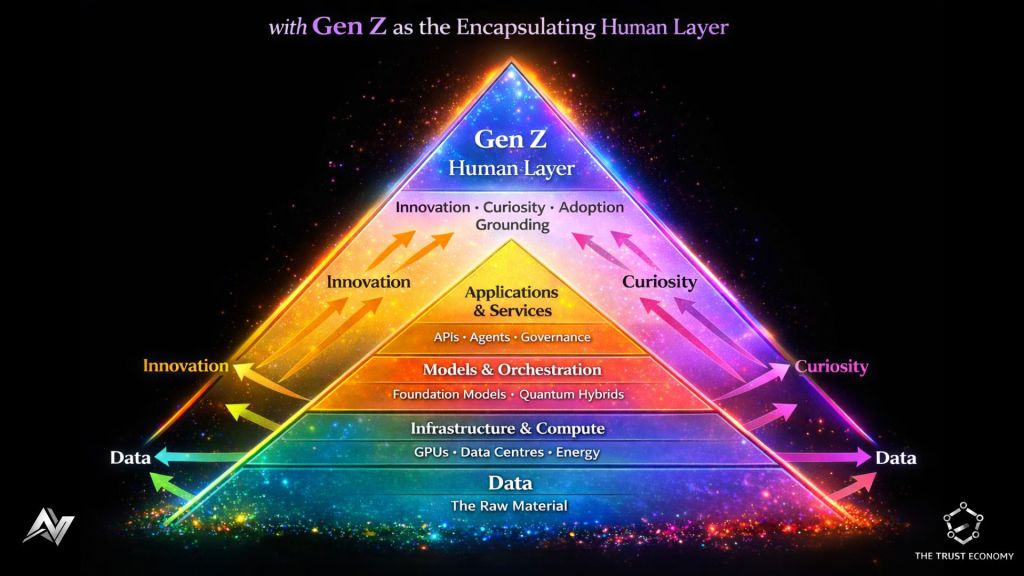
The larger outer pyramid creates a self-reinforcing pressure system: core science advances => middle service translation => outer adoption feedback => stronger core science. This is the slingshot mechanism. It turns yesterday’s constraints (energy, accessibility, complexity) into tomorrow’s exponential opportunities.
The Hypothesis: Gen Z as AI’s Encapsulating Slingshot – Evidence-Based Assumptions
Grounded in March 2026 data, six conservative yet powerful assumptions emerge:
Talent multiplier effect: Global demand for AI roles is already crossing 1 million new positions every year, and Gen Z is upskilling two to three times faster than previous generations. This means adoption timelines in youthful nations can shorten by 3 to 5 years. The well-known PwC projection of $15.7 trillion in global AI-driven GDP growth by 2030 will be shared more widely once this outer human pyramid is fully active.
Efficiency and sustainability push: Gen Z’s natural understanding of physics and chemistry will push for smaller, greener models and better materials. When combined with ongoing hardware improvements of about 30 to 40 percent per year, this could reduce projected data-center power growth by 10 to 20 percent by 2030.
Democratization at scale: The pressure from core innovation all the way to everyday use will bring AI to small and medium businesses, smaller cities, non-technical users, and people who speak languages other than English — at a speed we have never seen before. Affordable devices, local-language models, and young builders are already turning AI from something only big companies can use into a tool everyone relies on daily.
Core innovation acceleration: Hybrid quantum-AI breakthroughs and advanced agent systems will arrive 3 to 5 years earlier because thousands of young STEM minds, who are fearless with hard sciences, are experimenting every single day instead of waiting for big research labs.
Ethical and governance leadership: Having grown up with AI and trained in rigorous mathematics, Gen Z will naturally build responsible design into every layer, making regulations easier to follow and earning public trust much faster in youthful nations.
Transition to Gen Alpha: By 2035, the oldest members of Gen Alpha (born 2013 onward) will start entering the workforce. They will take the outer encapsulating pyramid even further, with an even more natural connection to AI agents and quantum tools.
Challenges and Balanced View
Talent gaps persist in certain ultra-niche areas (advanced quantum hardware fabrication). Infrastructure bottlenecks remain real in many emerging markets. Regulatory uncertainty and ethical questions loom large. Youthful nations must invest in quality education, mentorship, and infrastructure – not just quantity of graduates. Ageing economies can still compete through immigration, experience capital, and strategic partnerships. The outer pyramid is powerful but not automatic – it requires deliberate policy, investment, and cross-generational collaboration to reach full strength.
Long-Term Futurist View: 2035–2040 and Beyond
By 2035, data-center demand may reach 1,300 TWh globally, yet per-model energy intensity could be 30–50% lower thanks to Gen-Z-designed efficient architectures and quantum-assisted optimization rooted in hard-science curiosity. Quantum-AI hybrids will solve climate modelling at the planetary scale, personalized medicine for billions, fusion control systems, and materials discovery that enables carbon-negative infrastructure. The outer encapsulating pyramid will have matured into a global talent mesh connecting youthful innovators across Asia, Africa, and Latin America directly to research campuses worldwide.
Looking further to 2040–2050, AI will be infrastructure like electricity – ubiquitous, affordable, and governed primarily by the generation that grew up with it and the one that follows. Edge devices will run sophisticated agentic systems offline. Service layers will be fully autonomous yet human-supervised. Core research will be democratized through global open-science platforms. The countries that nurtured their Gen Z encapsulating force today will lead in economic vitality, technological sovereignty, and human-centric innovation. Those that did not will import both the technology and the future.
The Futurist Prediction
As a futurist, reflecting on the shifts unfolding in March 2026 – witnessing Gen Z’s remarkable curiosity and drive to upskill, young minds bridging hard sciences with practical innovation, and demographic changes reshaping progress worldwide, I’ve come to this grounded prediction:
The 2030s will not be remembered for bigger GPUs or more data alone. They will be remembered as the decade when the outer encapsulating human innovation pyramid – powered by Gen Z and the next Alpha wave in youthful nations – became the decisive force in AI evolution. The slingshot is already loaded. The nations that treat their young STEM talent as the overarching force surrounding the entire stack today will own the AI century. The rest will import both the technology and the future.
The next evolution is no longer coming. It is being built, right now, by the generation that grew up believing they could- and should – redesign the entire stack from the inside out!
The outer pyramid is live.
The future just got human…
References
- International Energy Agency (IEA). (2026). Electricity 2026. Paris: IEA.
- Stanford Institute for Human-Centered Artificial Intelligence. (2025). AI Index Report 2025. Stanford University.
- McKinsey & Company. (2025). Quantum Technology Monitor 2025.
- Deloitte. (2025). Gen Z and Millennial Survey 2025: Global Edition.
- United Nations Department of Economic and Social Affairs. (2024). World Population Prospects 2024 (with 2025–2026 updates).
- Central Intelligence Agency. (2026). The World Factbook.
- PricewaterhouseCoopers (PwC). (2025 update). Sizing the Prize: The Real Value of AI to the Global Economy.
#AficialIntelligence #FutureOfAI #GenZ #Innovation #AITalent #FutureOfWork #TechStrategy #DigitalTransformation #AILeadership #TechInnovation #QuantumComputing #MachineLearnirting #AIEcosystem #STEMEducation #GlobalInnovation
 ARYON VANCE
Leave a comment