
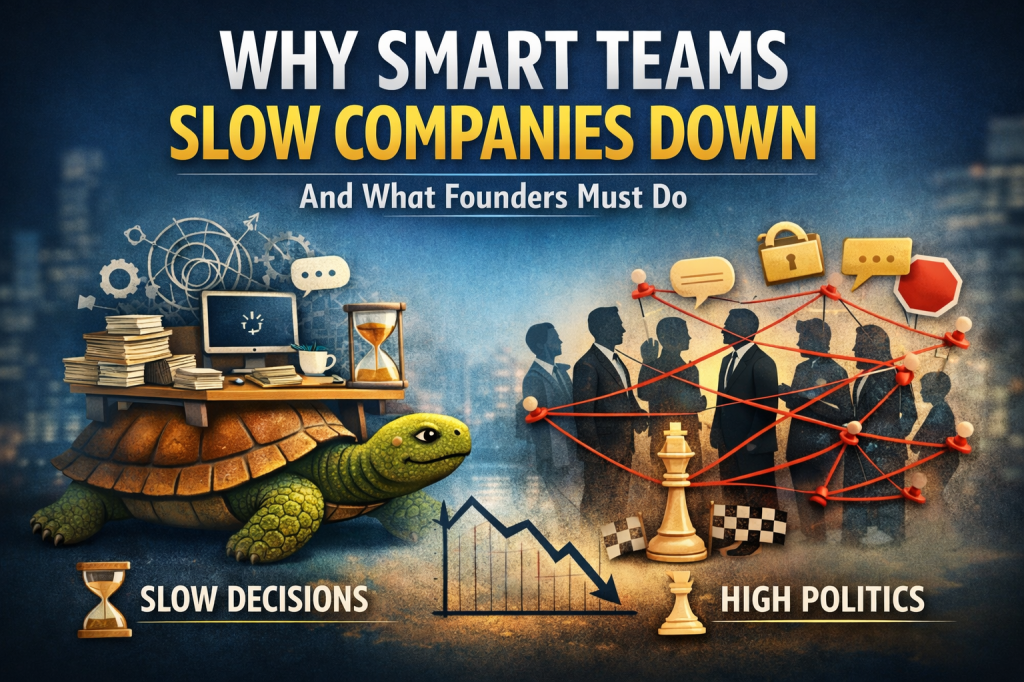
INTRODUCTION – WHAT I’VE LEARNED WATCHING COMPANIES SCALE (AND STALL)
Across industries, geographies, and growth stages, I’ve repeatedly seen a pattern that most leadership literature underplays:
Companies rarely fail to scale because of technology.
They fail because of human system design.
Founders initially assume data, AI, or automation will determine their trajectory. But over time, it becomes clear that what actually determines scale is how quickly insight travels, how safely truth can be spoken, and how little politics interferes with execution.
This essay reflects what I’ve learned watching organizations grow, stall, reset, and grow again.
DATA VELOCITY: THE DIFFERENCE BETWEEN INTELLIGENCE AND ARCHAEOLOGY
Many organizations proudly show dashboards. Few examine whether those dashboards influence decisions in time.
In one infrastructure company I advised, the analytics team produced exceptional reports. But by the time those reports reached leadership, decisions had already been made based on intuition.
The data was correct.
The timing was wrong.
The impact was zero.
That experience reinforced something for me: data only creates advantage when it moves faster than hierarchy.
WHEN GROWTH OUTPACES EMOTIONAL READINESS
The first real scaling crisis in most companies is not operational – it is psychological.
I’ve seen senior leaders who built the company’s early engine suddenly struggle when new talent arrives. Not because the new talent is better, but because the arrival signals that the organization is evolving beyond its founding identities.
People rarely resist change openly.
They resist it structurally.
They introduce more reviews.
They ask for more context.
They expand approval layers.
They delay decisions in the name of prudence.
Individually, each step feels rational.
Collectively, they slow the company.
SUCCESSION POLITICS: THE CONVERSATION NOBODY HAS OPENLY
One of the clearest inflection points in scaling companies is when leaders begin quietly calculating their future relevance.
I once worked with a fast-scaling digital services firm where the founder complained that execution had slowed dramatically. When we mapped decision flows, we found that three senior leaders had independently built approval loops that routed through them – not because they were necessary, but because they ensured visibility.
None of them saw themselves as political.
They saw themselves as responsible.
Yet the outcome was identical to politics: velocity collapsed.
THE ‘INTELLECTUAL FLOAT’ TRAP
I’ve also seen companies stall because they hired too many brilliant people at once.
This sounds counterintuitive, but it happens frequently.
In one global product organization, every meeting turned into a design critique. Every idea triggered three alternative frameworks. Weeks were spent refining solutions that could have been deployed in days.
The team was exceptionally smart.
The company became exceptionally slow.
That experience convinced me that execution discipline matters more than analytical horsepower once basic competence is achieved.
WHY TRANSPARENCY SCALES BETTER THAN BRILLIANCE
Over time, I’ve come to value transparent operators more than dazzling strategists.
The most valuable leaders I’ve seen share three traits:
They surface problems early.
They clarify ownership quickly.
They make decisions visible.
These behaviors compound trust.
Opacity, on the other hand, creates invisible drag. Teams waste time interpreting signals instead of executing tasks.
ORGANIZATIONAL DESIGN AS A SPEED MULTIPLIER
One founder once told me, “Our org chart is confidential.”
That statement alone explained their execution issues.
If people cannot see how decisions move, they hesitate.
If they hesitate, they escalate.
If they escalate, velocity drops.
The most scalable organizations are not those with the most sophisticated structures. They are those with the clearest ones.
RELATIONSHIP CAPITAL: THE HIDDEN OPERATING SYSTEM
In multiple transformations I’ve seen, trust between teams predicted success more than budget or tooling.
When teams trusted each other, they shared problems early.
When they didn’t, they protected their domains.
The difference determined whether issues were solved in days or discovered in quarters.
Relationships are not culture posters.
They are execution infrastructure.
DECISION LATENCY: THE METRIC I WISH MORE BOARDS TRACKED
If I could add one KPI to every board dashboard, it would be decision latency.
How long does it take to:
approve hiring,
resolve conflicts,
kill failing projects,
launch pilots?
When that time expands, growth quietly decelerates even if revenue still rises temporarily.
WHAT FOUNDER MATURITY REALLY LOOKS LIKE
Founder maturity is not about vision statements or public narratives.
It is about recognizing that at scale, the founder’s job shifts from solving problems to designing systems that solve problems without them.
That means designing:
clear authority,
visible ownership,
fast escalation paths,
and cultural norms that reward truth over comfort over Intellectual Float.
TEN DESIGN PRINCIPLES I’VE SEEN WORK REPEATEDLY
1. Simplify reporting lines constantly
2. Reward transparency publicly
3. Reduce approvals wherever possible
4. Build succession pipelines early
5. Encourage dissent but enforce decision closure
6. Track decision speed
7. Document ownership
8. Invest in relationships
9. Align incentives with outcomes
10. Reboot structures periodically
CONCLUSION — SCALE IS HUMAN DESIGN
AI will evolve. Data systems will improve. Automation will accelerate.
But the organizations that endure will be those that master something more fundamental:
the design of human systems.
Because ultimately, the difference between companies that stall and those that scale is not intelligence, capital, or technology.
It is whether truth can travel faster than politics.
And whether decisions can travel faster than fear.
#TrustEconomy #ScalingOrganizations #FounderLeadership #OrgDesign #DecisionSpeed #StartupScaling #LeadershipStrategy #ExecutionCulture #BusinessTransformation #OperatingModel #DataVelocity #AILeadership #DigitalTransformation #DataStrategy #BoardroomInsights #FounderMindset #LeadershipThinking #FutureOfWork
 ARYON VANCE
Leave a comment