The operating model powering business transformation for scalable startups.
The Trust Economy is a practical operating model for scaling startups.
It treats trust as a strategic input designed into how decisions are made, work is executed, and accountability is held.
When trust is absent, complexity explodes.
When trust is operationalized, scale accelerates.
The Five Dimensions of Trust
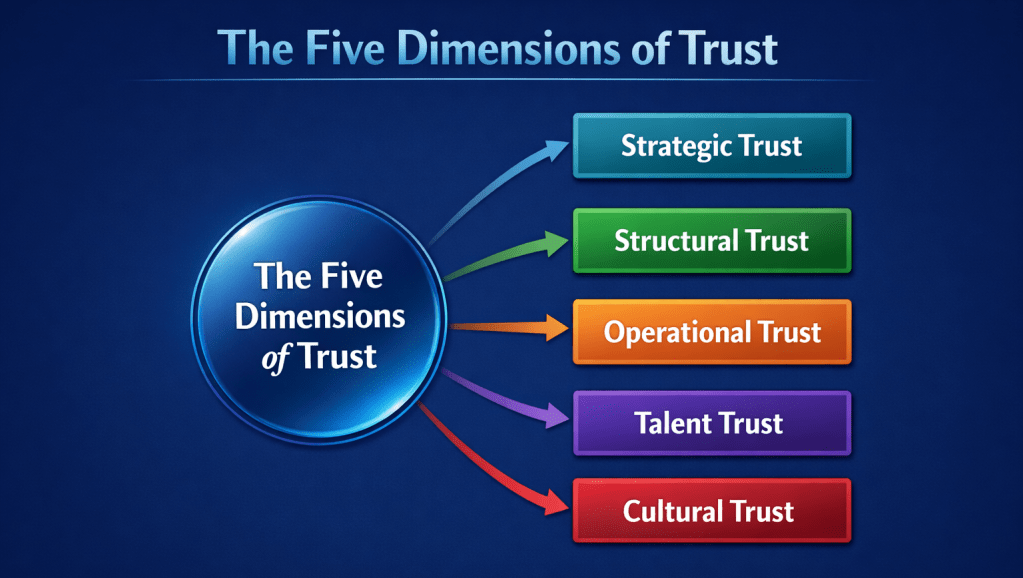
1. Strategic Trust
Everyone knows what game they are playing.
Strategic trust exists when:
- Direction is unmistakably clear
- Tradeoffs are explicit
- Decision authority is understood
Without it, teams hedge, align upward, and slow down.
2. Structural Trust
The organization reinforces strategy instead of fighting it.
Structural trust is created through:
- Intentional org design
- Clear accountability
- Authority matched to responsibility
When structure and strategy are misaligned, trust erodes fast.
3. Operational Trust
Execution becomes reliable, not heroic.
Operational trust shows up as:
- Commitments that stick
- Transparent workflows
- Early signal detection instead of late-stage firefighting
Lack of trust always gets replaced by bureaucracy.
4. Talent Trust
People take ownership because the system supports them.
Talent trust exists when:
- Expectations are explicit
- Leaders are developed, not overused
- Psychological safety enables accountability
High performers stay where trust is built into the system.
5. Cultural Trust
Culture is proven under pressure.
Cultural trust is reinforced by:
- Leader behavior when stakes are high
- Consistent decision logic
- Consequences that match stated values
Culture is not what you say. It’s what your systems allow.
Outcome
Startups that operate in the Trust Economy gain:
- Faster, cleaner decisions
- Strong ownership at every level
- Reduced friction as complexity grows
- Execution that scales with the business


 ARYON VANCE