In today’s world, the unexpected is routine. What were once Black Swan events-rare, high-impact shocks-now happen several times a year. The Red Sea shipping attacks through 2024 and 2025 clogged global trade routes for months. The Panama Canal drought slowed cargo flows, which everyone assumed would always run smoothly. New disruptions in the Middle East and Eastern Europe continue to break supply chains. Cyber incidents have knocked major healthcare and finance systems offline with little warning. In the 2026 Allianz Risk Barometer, over half of the thousands of global risk leaders cited supply-chain paralysis from geopolitics as their top fear; nearly half pointed to a global internet outage from cyberattacks.
These shocks are no longer rare. The World Economic Forum’s Global Risks Report for 2025 and 2026 lists armed conflict, extreme weather, geoeconomic fights, and cyber threats as dominant risks. Businesses sticking to annual risk routines keep getting caught off guard. Yet every shock is also a chance for the prepared: a shipping delay can create new partnerships; a cyber scare can prove your systems are reliable.
This article gives you a complete, practical framework that any organization can use right now – whether you run a factory, a tech firm, a logistics company, or a service business. It helps you spot signals early, sort the real threats from the noise, protect what matters, and even turn chaos into new growth. I built it from watching how smart leaders have handled the shocks of the past few years. It updates classic ideas from Nassim Taleb and Michele Wucker for the speed of today’s world. By the end, you will have the full system plus a clean visual you can copy straight into your own plans.
Let’s walk through it step by step.
Understanding Today’s Risk Landscape
Clear definitions help everyone stay on the same page.
A True Black Swan is something truly rare and almost impossible to see coming. The 2008 financial crash or the sudden spread of COVID-19 fit this category. No one could predict the exact timing, but once they hit, the world changed for good.
A Gray Rhino is different. It is big, visible, and charging right at you – yet many companies pretend it is not there. Repeated extreme weather warnings, or the rising tensions in key shipping lanes before the 2024 Red Sea attacks, are classic examples. Everyone saw the risk building, but action came too late for some.
Then comes the hopeful version: Black Swan with a Diadem. These look like pure trouble at first, but quick thinkers turn them into big wins. When Middle East tensions grounded planes and blocked routes in recent years, some logistics and maintenance businesses opened new corridors and partnerships while others simply lost money.
The most dangerous type often sits inside your own walls: Assumption Blind Spots. These are risks you create yourself by clinging to old or unchallenged assumptions while building business cases, annual plans, or strategy documents. Maybe your plan still counts on steady supplier prices even after years of inflation shocks. Or you keep the same customer model while buying habits have completely shifted. Or you assume a key market will remain captive without checking new competitors. These hidden assumption gaps have quietly sunk more companies than any outside event – and they feel exactly like a Black Swan when they finally hit.
In 2026, these four types mix and hit faster than ever. The Allianz survey shows supply-chain paralysis from geopolitics as the number-one worry. The World Economic Forum ranks misinformation, extreme weather, and cyber warfare close behind armed conflicts. Companies that treat every shock as a surprise stay fragile. Those who build a system to watch, sort, and act pull ahead.
Why Traditional Risk Management Is Falling Behind
For decades, Enterprise Risk Management meant filling forms, drawing heat maps once a year, and handing reports to auditors. It worked when big events arrived once every ten years. It fails when they arrive every few months.
Recent numbers paint a clear picture. The World Economic Forum’s 2026 report shows geoeconomic confrontation and economic worries climbing fast. Many firms that relied only on lag indicators – watching sales drop after the damage was done – lost weeks of revenue during the 2024–2025 Red Sea disruptions. They reacted after the fact instead of moving early.
Human habits make things worse. After an event happens, we rewrite history in our minds and say, “Of course, we saw it coming.” This creates false confidence for the next round. Boardrooms fall into groupthink, and short-term targets push real preparation aside.
Modern risk work must do two jobs at once: defend against losses and hunt for gains. It must move from lag indicators (what already went wrong) to lead indicators (early warnings like rising shipping insurance or sudden cyber alerts). It must review plans every quarter, not just once a year. And the risk team must become a partner in strategy, not just a compliance box-checker.
The Black Swan Resilience Framework: Five Clear Pillars
The system is simple and works in any industry. It rests on five easy-to-follow pillars.
Pillar 1: Sort Your Risks. Put every possible event into eight practical buckets: geopolitical conflict, regulatory and tech changes, climate and health issues, shifts in customer demand, cyber and infrastructure failures, economic waves, supply-chain breaks, and your own assumption blind spots. Plot them on a living heat map that shows probability, impact, and speed. Update it regularly. The Red Sea crisis started in the geopolitical bucket but quickly touched supply chains and costs.
Pillar 2: Scan Continuously Keep watch on global signals using free or low-cost tools. Open platforms like World Monitor pull together news, satellite views, ship tracking, and conflict alerts. Add your own data – customer trends, supplier messages, or market prices. The goal is steady awareness without overload.
Pillar 3: Filter and Detect. Not every headline matters. Use simple rules or light AI to pick out the weak but important signals. Color-code them: green for normal watching, yellow for a closer look, red for immediate action. Companies that filtered well in 2025 spotted cyber patterns weeks before the big incidents hit.
Pillar 4: Analyze and Challenge Assumptions Every yellow or red signal triggers a quick check: Does this change what we wrote in our plans? Track lead indicators such as route delays, sentiment shifts, or insurance spikes. Do this every quarter with your team. It keeps plans honest and up to date.
Pillar 5: Respond with Two Paths. Every signal splits into two roads. The threat road activates protection steps. The opportunity road looks for new ways to grow. Quick fixes might mean rerouting shipments; bigger moves might mean new partnerships or products. This dual approach turns reaction into a real advantage.
The whole process forms a closed loop: scan, filter, detect, analyze, respond. It comes back to scanning, so you never stop learning. This loop is what moves a company from fragile to antifragile – stronger after each shock.
Scanning and Spotting Signals in Real Time
Scanning is like keeping a business weather radar running all the time.
Take the 2024–2025 Red Sea situation. News showed rising attacks for months. Smart teams tracked shipping alerts and insurance costs early. They moved cargo to safer routes or air freight, while others waited and lost money. The difference was having a scanning habit in place.
Today’s tools make it straightforward. Open platforms give satellite port views, real-time conflict maps, and quick summaries of thousands of sources. Mix in your internal numbers – slowing orders in one region or supplier delay emails – and patterns appear fast. Set simple thresholds: if several signals line up in the same bucket, flag it yellow. If money is clearly at risk, go red. A small team reviewing weekly can catch most issues before they grow.
Mapping Impact and Capturing Opportunities
No shock hits every business the same way. A climate event might hurt farming but help renewable suppliers. A cyber outage might sink one retailer, but let another gain trust by staying reliable.
Create a simple impact table for your company. List your main activities and score how each risk bucket touches revenue, operations, rules, and long-term position. Do the same for upside. When Middle East tensions rose again in 2025, some transport firms used it to open fresh routes and sign new deals, while others canceled services.
Keep a short “tailwind playbook” next to your threat one. Ask: If this happens, what new customer need appears? What partnership could we start? What service could we offer first?
Firms that asked these questions during the recent supply crises finished the year with bigger market shares.
Making It Stick: Governance and Daily Habits
Your risk or strategy team becomes the central hub. They keep the master list of possible events, send quarterly updates to every department, and make sure assumption checks happen on time. Add a short self-assessment page to your regular planning templates: “What assumptions are we using? What early signals will tell us if they are wrong?”
Change meeting habits from “how did last quarter go” to “what signals are we seeing now.” This keeps everyone looking forward. Keep internal discussions honest and separate from formal board reports.
Step-by-Step Implementation Roadmap
Start small and build quickly.
Month 1: Build your risk buckets and heat map. Set up basic scanning even with a shared spreadsheet.
Month 2: Walk department leaders through the approach. Ask each to list their top risks and draft one-page playbooks.
Month 3: Hold your first quarterly assumption review. Test one recent real-world signal.
Month 4 and beyond: Turn on color-coded alerts and dual-path responses. Review and improve every quarter.
Most teams see fewer surprises and faster decisions within six months – plus new revenue they never planned for.
Real Stories from the Past Few Years
The 2024–2025 Red Sea attacks showed the difference clearly. One global logistics firm caught the early signals through tracking tools. They rerouted ships ahead of time and offered “secure corridor” services. Competitors who waited lost weeks and customers. The prepared firm grew revenue by nearly 20 percent that year.
A manufacturing company had watched semiconductor worries for years. When new tensions hit supply lines in 2025, they already had backup sources ready. While others shut production, this firm increased output and gained market share.
A retail business used to assume steady customer prices. Recent inflation waves forced them to challenge that assumption blind spot. They tested flexible pricing and new suppliers. When the next economic pressure hit in 2025, they adjusted fast and kept their customers loyal.
These outcomes did not come from luck. They came from having a working system before the trouble arrived.
Key Managerial Takeaways
Here are the clear lessons every leader should remember:
- Black Swan-type events now arrive several times a year in our connected world. Treat preparation as an ongoing habit, not a yearly task.
- Build defense and offense together. Every risk carries possible upside. The winners are the ones who look for it.
- Move from lag to lead indicators. Stop waiting for bad results to show up. Track early warnings like shipping delays, cyber alerts, or customer changes.
- Review assumptions every quarter. Make it normal in every team. Unchecked assumptions create the worst blind spots.
- Turn your risk team into strategic partners. Let them scan, filter, and flag opportunities across the whole organization.
- Keep playbooks short and clear – one page each: who acts, how, when, and what the opportunity side looks like. Test them in quick drills.
- Begin this week with a basic heat map and one scanning tool. Momentum matters more than perfect software.
- Turn every yellow or red signal into two questions: “How do we protect?” and “How do we win?” That simple habit changes everything.
Follow these, and your organization moves from fragile to antifragile – ready for whatever comes next and stronger because of it.
The Black Swan Resilience Framework (per the illustration below) brings structure to uncertainty by organizing how organizations detect, interpret, and act on high-impact disruptions. It begins with a broad set of external risk domains, ensuring that no major category of disruption is ignored. From there, the framework flows through three operational stages: detection of early signals, analysis of event types and underlying assumptions, and response through both defensive and opportunity-led actions.
What makes the model particularly powerful is the integration layer beneath these stages. By mapping every signal to enterprise-level impact-across operations, regulatory exposure, and strategic positioning-it ensures that risk is not treated in isolation but as a core business variable. Finally, governance sits at the foundation, positioning enterprise risk management not as a compliance function but as a strategic custodian that continuously aligns awareness, decision-making, and execution.
Together, the framework shifts organizations from reactive risk handling to proactive advantage creation.
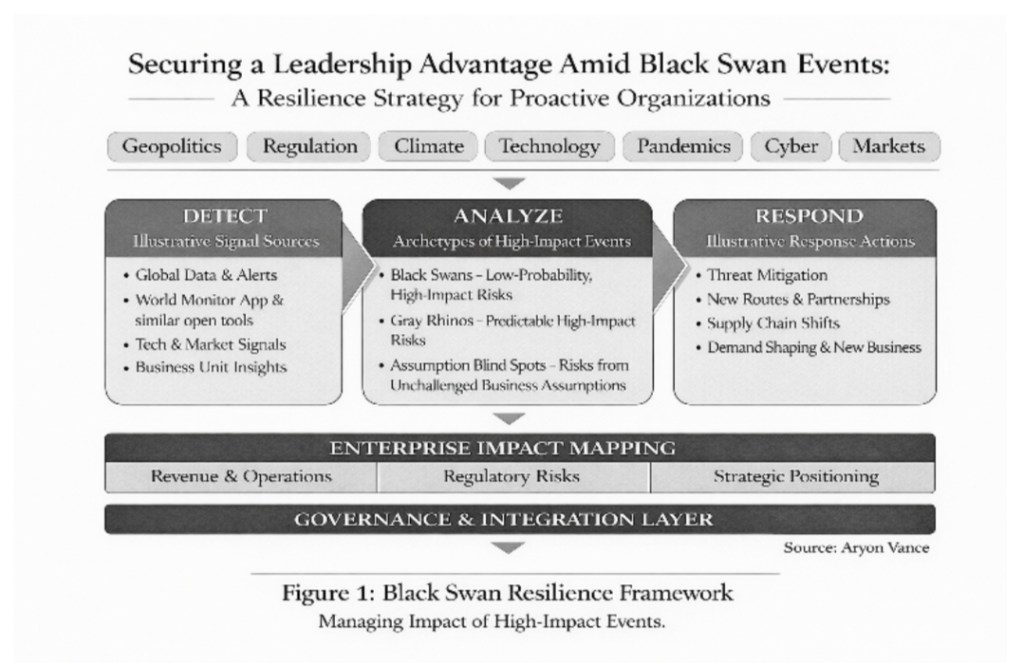
The Black Swan Resilience Framework – Visual Overview
Source: Aryon Vance – Black Swan Resilience Framework (March 2026)
Final Thoughts
The world will not become calmer anytime soon. But you can become smarter and faster. The framework in this article gives you a straightforward way to stop fearing uncertainty and start using it. Organizations that put it in place do not just survive the next shock – they come out stronger, quicker, and often larger than before.
Start this week. Draw your heat map. Pick one scanning tool. Run one assumption check with your team. In six months, you will wonder how you ever managed without it.
The future belongs to those who see the signals early, protect what matters, and seize the opportunities hiding inside every storm.
References
- Taleb, Nassim Nicholas. The Black Swan: The Impact of the Highly Improbable. Random House, 2007.
- Wucker, Michele. The Gray Rhino: How to Recognize and Act on the Obvious Dangers We Ignore. St. Martin’s Press, 2016.
- Allianz Risk Barometer 2026. Allianz Commercial.
- World Economic Forum. The Global Risks Report 2025 and 2026.
- Business Reporter. “The Black Swan Era: Navigating Disruptive Events 2024–2025.”
- Risk Ledger. “Black Swan Supply Chain Cyber Risks 2026.”
- Politico Magazine. “The Incredible World-Altering Black Swan Events That Could Upend Life in 2025.”
- Open-source intelligence platforms, including World Monitor tools (2025–2026 updates).
 ARYON VANCE
Leave a comment