
How legacy loyalty, informal power, and trust signals shape governance and quietly determine whether new leadership succeeds or fails
Introduction: Continuity vs Control
For organizations built over decades, the founder’s role inevitably evolves from building success to safeguarding continuity. This transition is rarely linear. It is not just about systems or strategy; it is about redistributing trust and authority in a way that preserves the past while enabling the future.
At the heart of this transition lies a structural tension.
On one hand, founders rely on long-standing leaders individuals who have demonstrated loyalty, protected the organization during uncertainty, and internalized the founder’s philosophy.
On the other, growth demands the induction of new leaders who bring fresh thinking, independent judgment, and new capabilities.
Most founders attempt to balance both.
But in doing so, they often create a system where:
- legacy influence remains strong
- new authority remains conditional
- and decisions move slower than intended.
The result is not conflict.
It is something far more subtle and far more dangerous:
A system where consensus is visible, but conviction is absent. - The Rise of “Mass Consensus” in Founder-Led Firms
A recurring pattern in mature founder-led organizations is the tendency toward mass
syndication of decisions.
This manifests as: - extended cross-functional alignment loops
- multiple layers of consultation
- insistence on “everyone being on board”
At face value, this appears inclusive and collaborative.
In reality, it often reflects a deeper hesitation:
The founder’s reluctance to disrupt long-standing loyalties
Founders, particularly in later stages, become increasingly cautious about: - alienating legacy leaders
- triggering perceived power shifts
- or unsettling established relationships
As a result, they encourage broader alignment before decisions are finalized.
While well-intentioned, this creates two systemic consequences: - Decision velocity declines
- Decision ownership becomes diffused
And most critically:
The organization begins to prioritize agreement over effectiveness
The Trust Economy: The Hidden Driver
As reflected in the underlying analysis , organizations do not operate purely on formal governance structures. They operate on what can be described as a Trust Economy.
In this system:
- Trust determines influence
- Influence determines outcomes
Employees quickly learn: - whose opinion matters most
- who shapes decisions informally
- who aligns closest with the founder
This creates a parallel hierarchy where: - formal authority does not equal real authority
- new roles do not automatically translate into decision power
Where trust is placed, power follows.
The “Forced Consensus” Phenomenon
One of the most nuanced and under-recognized dynamics in such environments is forced
consensus.
Legacy leaders often unintentionally play a central role in shaping it.
They:
- encourage open discussion
- acknowledge new ideas
- appear supportive of change
But gradually: - frame risks in ways that favor historical approaches
- steer conversations toward familiar outcomes
- influence others through subtle authority
Illustrative Scenario (Anonymized)
In a diversified organization (similar to the “ABC Group” described in the source analysis ), a cross-functional transformation initiative was launched.
A senior, long-standing leader facilitated the discussion. - New Leader : “We should fundamentally rethink this model.”
Senior Leader:
“That’s a valid perspective. But we must also consider what has worked historically.”
Another Leader:
“Yes, we should strike a balance.”
Senior Leader (closing):
“So we align on refining the current approach?”
Agreement follows.
No visible resistance. No conflict.
But also, no meaningful change.
The outcome is labeled consensus, but it is in fact guided convergence shaped by legacy
influence.
Why New Leadership Struggles to Land
Research from McKinsey & Company and John Kotter consistently shows that transformation
fails when new leadership is not truly empowered, even if formally appointed.
The failure pattern is consistent across industries:
- New leaders are hired to drive change
- They introduce new ideas
- Their ideas enter consensus-heavy systems
- Those ideas are moderated and diluted
- Over time, they adapt or disengage
This creates what can be termed:
Structural fatigue of the new order
Global Patterns Across Organizations
Germany – Precision vs Adaptability
Legacy engineering leaders emphasize precision and risk control.
Innovation is discussed, but rarely accelerated.
India – Culture as a Shield
“Culture” becomes a justification for preserving legacy systems.
Change is acknowledged but softened.
United States – Channel Protection
Legacy sales leaders defend existing revenue models.
Digital transformation slows due to over-alignment.
Japan – The Silence Effect
New leaders gradually stop challenging.
Not due to disagreement but due to systemic fatigue.
Middle East – Governance vs Influence
Formal governance exists.
But informal advisory influence overrides decisions.
The Consultant Paradox
Organizations often bring in firms such as:
- Boston Consulting Group
- Bain & Company
- McKinsey & Company
These firms succeed not only because of expertise, but because:
The founder temporarily reallocates trust
Their recommendations are: - heard
- protected
- implemented
This reveals a critical truth:
Organizations are capable of change but only when trust is consciously redirected
The Solution: A Leadership Evolution Framework
The answer is not the removal of legacy leaders.
It is the structured evolution of roles, trust, and governance.
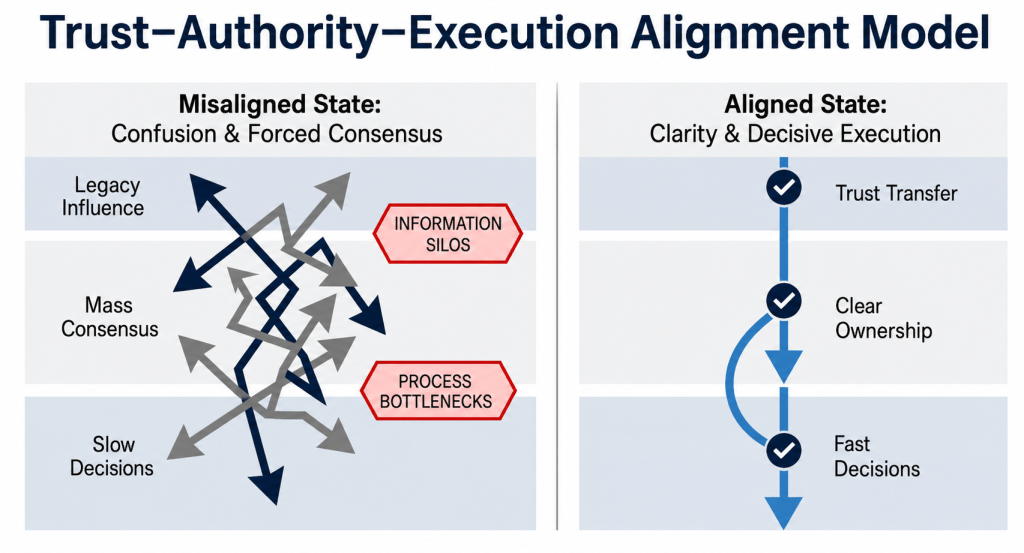
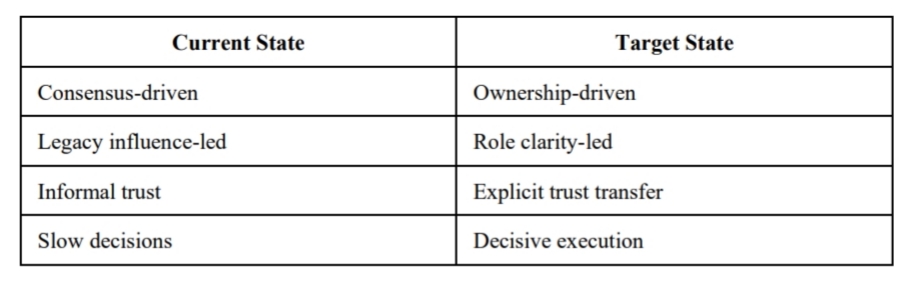
Core Shift Required
Current State Target State
- Consensus-driven Ownership-driven
- Legacy influence-led Role clarity-led
- Informal trust Explicit trust transfer
- Slow decisions Decisive execution
The Leadership Evolution Playbook
- Elevate, Don’t Eliminate
Legacy leaders should transition into advisory, mentorship, and stewardship roles preserving their contribution while reducing operational control. - Define Decision Ownership Clearly
Every major decision must have a single accountable owner. Consensus should inform decisions, not replace ownership. - Transfer Trust Explicitly
As highlighted by McKinsey & Company, transformation succeeds when leaders create space for others to act. Founders must visibly back new leadership. - Limit “Consensus Inflation”
Not all decisions require alignment across layers. Define where consensus is needed and where speed and ownership matter more. - Protect New Leadership Energy
Repeated dilution leads to disengagement. Early wins and clear authority are critical. - Align Governance with Reality
As emphasized by Bain & Company, clear decision rights and accountability drive results.
Governance must eliminate shadow influence. - Institutionalize Leadership Renewal
Create structured pathways:
- Operator → Leader → Advisor
This ensures renewal is continuous, not reactive.
Managerial Takeaway
The tension between loyalty and renewal is one of the most defining challenges in founder-led organizations. While long-standing leaders bring invaluable institutional knowledge and continuity, their continued presence in operational roles can unintentionally shape decisions toward the past.
The instinct to seek broad consensus, while well-intentioned, often slows organizations down and dilutes accountability. Leaders must recognize that consensus is not always synonymous with alignment, and alignment is not always synonymous with effectiveness. In many cases, the pursuit of universal agreement masks deeper structural constraints.
The path forward lies in consciously evolving leadership roles. Legacy leaders must be elevated into positions where their experience informs direction without constraining execution. New leaders must be given clear ownership, visible backing, and the space to operate independently.
Ultimately, organizations mirror the behavior of their founders. When founders redistribute trust deliberately and signal clarity in decision-making, the system responds with speed, accountability, and innovation. When they hesitate, the system defaults to familiarity.
The real test of leadership is not whether change is discussed but whether the organization is structurally enabled to deliver it.
References
- McKinsey & Company – The Psychology of Change Management
- Boston Consulting Group – Transformation & Leadership Renewal
- Bain & Company – Results Delivery®
- John Kotter – Leading Change
- Microsoft transformation under Satya Nadella
 ARYON VANCE
Leave a comment